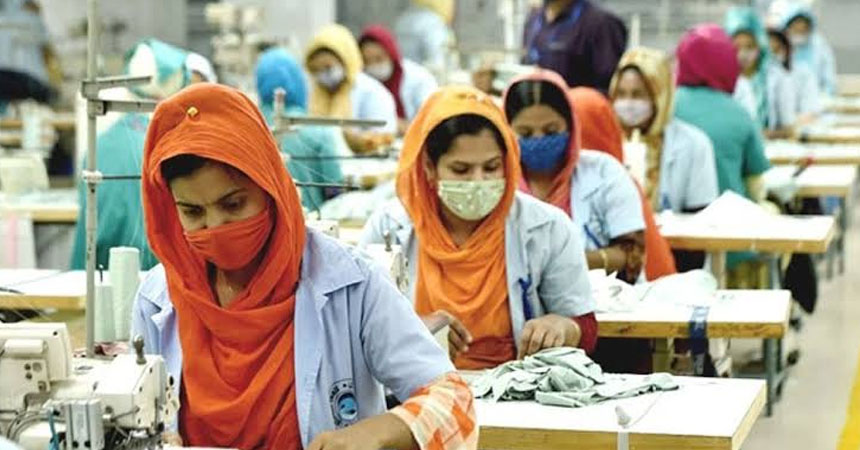
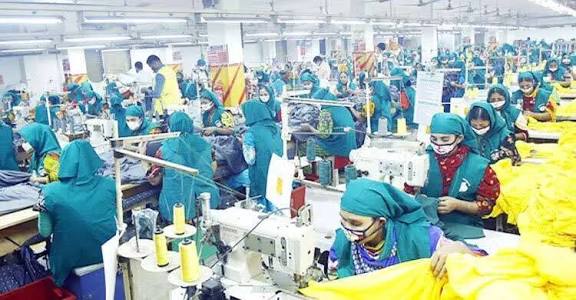
Yet, the income of these workers remains disproportional to the rising cost of living. As commodity prices and daily expenses surge, wages have failed to keep pace. Consequently, the readjustment of garment workers' wages has evolved beyond a mere labor demand into a vital question of economic stability and social justice.
Historical Growth and the Wage Disparity
Tracing its roots to the late 1970s, Bangladesh's RMG sector rapidly transformed into the nation’s largest export earner, propelled by abundant labor, competitive wages, supportive government policies, and surging international demand.
Currently, the industry employs approximately 4 million workers, the vast majority of whom are women. Their contribution to household economic security and female empowerment is profound. However, the workforce driving this multi-billion-dollar industry on the global stage continues to earn wages inadequate for basic subsistence.
Under the current government wage structure, the minimum monthly gross wage for a garment worker is fixed at BDT 12,500—roughly equivalent to USD 101. In stark contrast, average monthly earnings for garment workers in Pakistan and Indonesia range between USD 517 and USD 576 in purchasing power parity (PPP) terms. In Turkey, minimum wages for unskilled garment workers stand at approximately BDT 50,000, scaling up to BDT 72,000 for skilled personnel. These figures underscore the vast disparity in compensation faced by Bangladeshi workers internationally.
Despite enduring long working hours, low incomes, and adverse conditions, workers maintain production lines. However, a significant fraction continues to live below a comfortable threshold, often squeezed into congested, unhygienic housing while struggling to cover basic nutrition, healthcare, education, and safe commuting expenses.
The Wage Board and Current Negotiations
Amid these realities, upward wage revision has become an urgent imperative. While workers hold legitimate grievances, factory vandalism, arson, or violent protests remain unacceptable; demands must be pursued through peaceful, lawful channels. Simultaneously, factory owners must proactively address the root causes of worker discontent.
Recognizing the gravity of the crisis, the government has instituted a new six-member Minimum Wage Board, gazetted on November 1, chaired by District and Sessions Judge Syed Azad Sobhani. The board—comprising worker representatives, employer delegates, and an independent member—convened its second meeting on November 9, during which worker representatives placed a formal demand for a minimum monthly wage of BDT 32,000.
While employers were granted a short window to submit their counter-proposals ahead of subsequent board deliberations, tensions have flared. Reports of potential employer pushback—including threats to invoke Section 13(1) of the Labor Act (“no work, no pay”) if production halts persist—threaten to deepen friction and prolong industrial instability.
Economic Pressures and Inflationary Realities
Bangladesh’s broader economy is currently navigating severe macroeconomic headwinds. Introducing prolonged industrial unrest into this landscape will inflict compounding damage.
Official data underscores the squeeze on real wages: according to the Bangladesh Bureau of Statistics (BBS), inflation stood at 8.34 percent in September 2026, outpacing nominal wage growth (which hovered around 8.05 percent in August). Prolonged periods of inflation exceeding wage growth systematically erode workers' purchasing power.
Independent benchmarks corroborate worker demands. According to estimates by the Global Living Wage Coalition, the estimated living wage for a four-member family in Dhaka stands at BDT 30,459 per month—making workers' demands for a BDT 30,000 minimum wage closely aligned with empirical research.
Furthermore, International Labour Organization (ILO) Convention No. 131 explicitly dictates that minimum wage fixing should account for the needs of workers and their families, alongside broader economic factors and the cost of living.
Beyond the Balance Sheet: The Economics of Fair Wages
Viewing wages purely as an operational cost ignores vital economic principles. Economists George Akerlof, Carl Shapiro, and Joseph Stiglitz formulated the Efficiency Wage Theory, demonstrating that superior compensation enhances worker productivity, reduces turnover rates, and cuts down recruitment and training costs.
┌────────────────────────────────────────────────────────────────────────┐ │ GARMENT WORKERS’ WAGES & ECONOMIC CONTEXT │ ├────────────────────────────────────────────────────────────────────────┤ │ • Current Minimum Wage : BDT 12,500 (~USD 101) │ │ • Worker Demanded Wage : BDT 32,000 │ │ • Global Living Wage Ben.: ~BDT 30,459 (Dhaka, 4-member family) │ │ • Inflation (Sep 2026) : 8.34% (Outpacing nominal wage growth) │ │ • Current Wage Board : Chaired by Syed Azad Sobhani │ └────────────────────────────────────────────────────────────────────────┘Similarly, classical economic thinkers like Adam Smith argued that labor must command a return sufficient to sustain the worker and their dependents. In modern economic literature, fair compensation is recognized as a cornerstone of sustainable productivity.
However, placing the entire financial burden solely on factory owners is impractical. Global apparel brands and international buyers wield immense pricing power. A holistic approach requires shared responsibility among brands, factory owners, and policymakers to factor living wages into garment FOB (Free on Board) pricing.
Concurrently, the state can deploy social safety nets—such as subsidized rationing for low-income workers, affordable housing schemes, and dedicated transport subsidies—to cushion the transition.
Balancing Competitiveness and Sustainability
Employers frequently cite fierce regional competition from Vietnam and Cambodia, volatile global markets, and buyer resistance to price hikes as barriers to steep wage increases, warning that sudden shocks could bankrupt smaller factories and trigger mass layoffs.
While this vulnerability cannot be dismissed, no industry can remain viable in the long run by failing to cover the basic reproduction costs of its labor force. Fair wages foster morale, minimize absenteeism, and elevate product quality.
Ultimately, the long-term success of Bangladesh’s RMG sector cannot be measured purely by aggregate export volumes or factory counts. The ultimate metric of success is the standard of living enjoyed by the people whose labor built the industry. Ensuring fair wages is not merely an act of charity, but an essential capital investment in the future of the nation's economy.