
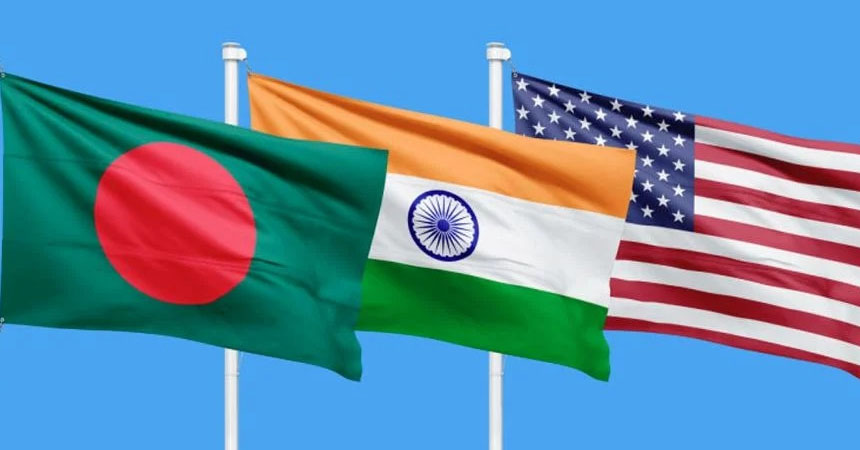
Dhaka is deepening economic ties with the United States, expanding infrastructure and other cooperation with China, while its relationship with neighbouring India is undergoing a fresh review.
The challenge for Bangladesh is how to maintain working relationships with competing powers while protecting its own economic and strategic interests.
Review of 101 India agreements
A recent development highlighting this challenge is the government's decision to review 101 agreements and memorandums of understanding signed with India during the previous Awami League government.
Chief Whip Nurul Islam Moni said on September 11 that the agreements were being reviewed and that the outcome would be announced soon. He said the government wanted to maintain friendly relations with India while giving priority to Bangladesh's national interests.
India said it had not received any official communication from Dhaka about the review.
Indian Foreign Ministry spokesperson Randhir Jaiswal said on September 18 that India had seen media reports about the issue but had not been officially informed. He added that New Delhi would take necessary steps to protect its interests.
The review does not, by itself, mean that all 101 agreements will be cancelled or amended. The government has not publicly announced such a decision.
The key issue will therefore be how the agreements are assessed, including their legal terms, economic impact, implementation, security implications, reciprocal benefits and potential long-term obligations.
A wider shift in Bangladesh's foreign policy
The review comes against the backdrop of broader changes in Bangladesh's relations with Washington, Beijing and New Delhi.
Bangladesh has traditionally followed the principle of maintaining friendship with all countries while avoiding permanent alignment with any particular power bloc. The current geopolitical environment is putting that approach under greater pressure.
The United States, China and India each have different interests in Bangladesh.
Washington is an important export market and economic partner. China is a major source of imports and an important infrastructure and investment partner. India is Bangladesh's immediate neighbour, with extensive links in trade, transport, energy, border management and water sharing.
These relationships cannot be treated as identical because the nature of Bangladesh's interests in each is different.
Expanding economic ties with the United States
Bangladesh's relationship with the United States has increasingly focused on trade and economic issues.
The two countries signed an Agreement on Reciprocal Trade on February 9, 2026. The agreement includes provisions on tariffs, market access and non-tariff barriers. Under the agreement, the United States will maintain a 19 percent reciprocal tariff rate on Bangladeshi goods, with specified products eligible for a zero percent rate. Bangladesh, meanwhile, committed to providing preferential market access to a range of US industrial and agricultural products.
The agreement also covers areas such as industrial standards, agricultural products and market access.
This has expanded the economic dimension of the Bangladesh-US relationship beyond earlier political and diplomatic disagreements.
For Dhaka, the challenge is to maximise access to the US market and investment while ensuring that new trade commitments remain consistent with long-term domestic economic interests.
China's expanding role
China's relationship with Bangladesh has also broadened considerably, covering infrastructure, trade, investment, energy, technology and other areas.
Prime Minister Tarique Rahman visited China from June 22 to 26, 2026, where he met President Xi Jinping and Premier Li Qiang. According to a joint communiqué issued after the visit, the two sides discussed bilateral relations as well as regional and international issues of common interest.
Infrastructure and economic cooperation remain important elements of the relationship.
Projects and discussions involving ports, industrial zones, transport infrastructure, renewable energy, technology and water management illustrate the breadth of China's engagement with Bangladesh.
At the same time, expanding cooperation does not automatically mean that Bangladesh has joined a particular political or military bloc.
The more immediate question is whether major infrastructure, financing, technology, energy or defence arrangements could create long-term dependencies. The terms of financing, repayment obligations, local economic benefits and technology transfer are therefore important considerations for Bangladesh.
Trade is another major issue.
China is one of Bangladesh's largest trading partners, but the relationship has long been marked by a substantial trade imbalance, with Bangladeshi imports from China far exceeding exports to the Chinese market.
Expanding exports, diversifying markets and increasing the domestic benefits of Chinese investment will therefore remain important elements of Bangladesh's economic relationship with Beijing.
The India factor
Bangladesh's relationship with India has a different character because of geography and the depth of bilateral interdependence.
The two countries share a border of more than 4,000 kilometres and are connected through trade, transport, electricity, border management, river systems and people-to-people links.
Political changes in Bangladesh since 2024 have added new complications to the relationship. The presence of former Prime Minister Sheikh Hasina in India, border issues, trade and connectivity, and water-sharing arrangements have all become subjects of diplomatic discussion.
The relationship therefore cannot be understood only through the lens of US-China competition.
Reviewing 101 agreements is one part of a broader reassessment. But whether individual agreements should be retained, amended or cancelled would require an examination of their specific terms and outcomes rather than simply the identity of the government that signed them.
Water sharing remains a key issue
The Ganges Water Sharing Treaty is another major issue in Bangladesh-India relations.
The 1996 treaty is scheduled to expire in December 2026. Indian officials have said bilateral mechanisms and technical-level discussions on the issue will continue.
The future of the treaty, along with the long-running dispute over the Teesta River, means water diplomacy will remain an important part of Bangladesh's engagement with India.
Other issues, including border management, trade, energy and connectivity, will also require sustained bilateral dialogue.
Balancing interests in a competitive region
Bangladesh's geographic position makes complete disengagement from major-power competition difficult.
India and China have competing strategic interests in South Asia, while the United States has expanded its economic and strategic engagement in the wider Indo-Pacific.
For Bangladesh, this creates both opportunities and risks.
US market access can support exports and investment. Chinese infrastructure and industrial cooperation can provide financing and technology. India's geographical proximity creates opportunities for transport, energy and regional connectivity.
At the same time, excessive dependence on any single partner could create economic or strategic vulnerabilities.
This makes diversification an important element of Bangladesh's foreign economic policy.
From foreign policy to economic security
Energy security is also becoming closely linked to foreign policy.
Bangladesh relies on imported LNG and other fuels, making international prices, shipping routes and supply disruptions important factors for domestic power generation and industrial production.
Diversifying suppliers, expanding domestic gas exploration, improving energy infrastructure and developing renewable energy can therefore strengthen both economic and strategic resilience.
The same principle applies to infrastructure and technology.
Foreign-funded projects can provide capital and expertise, but Bangladesh also needs to consider environmental impacts, operating costs, debt obligations, technology dependence and the long-term economic value of each project.
The test of strategic autonomy
Bangladesh is not currently defined by membership in a single geopolitical bloc. Its relationships with the United States, China and India are based on different sets of interests and dependencies.
The review of the 101 India agreements has brought this reality into sharper focus.
The outcome will depend not only on which agreements are changed, but also on the process used to assess them. Transparent criteria, institutional capacity, legal review, economic analysis and sustained diplomatic engagement will be important.
The broader challenge is to maintain cooperation without allowing external relationships to unnecessarily restrict Bangladesh's policy choices.
For Dhaka, strategic autonomy does not necessarily mean reducing relations with major powers. It can instead involve diversifying economic and diplomatic partnerships, assessing each agreement on its own merits and ensuring that foreign policy decisions remain linked to national economic, security and sovereignty interests.
As competition among major powers continues to reshape Asia, Bangladesh's ability to manage these relationships without becoming excessively dependent on any one partner will remain a central test of its foreign policy.