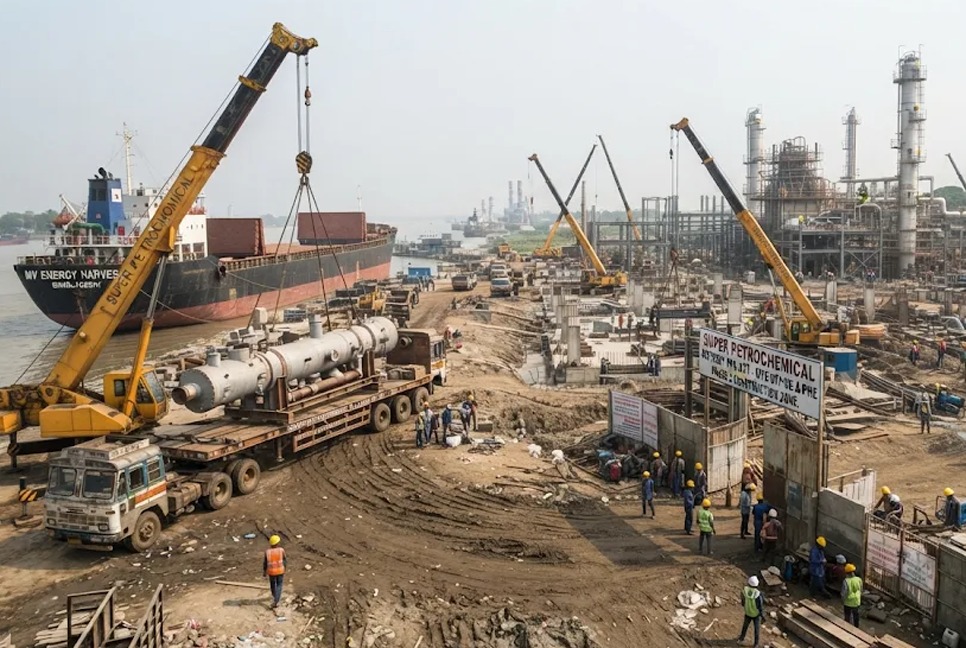
Briefing reporters on Thursday afternoon following an on-site inspection on Wednesday evening, Mohammad Zahid Hossain, BPC General Manager (Commercial & Operations) and head of the seven-member probe committee, revealed that the enterprise neither sought nor obtained BPC permission to import the massive volume of capital machinery and equipment utilized in the project.
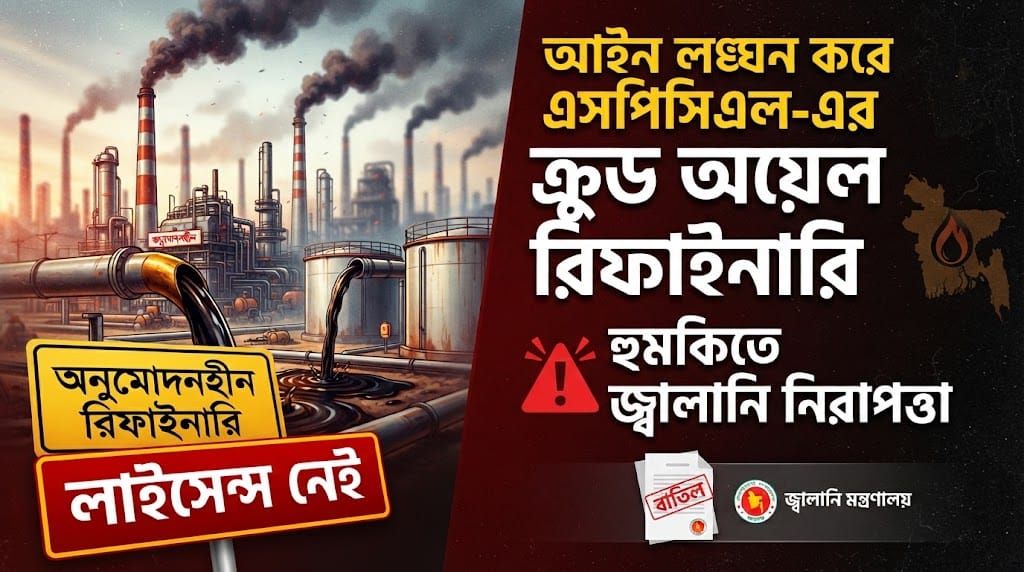
According to Section 7.1 of the 'Policy on Setting Up Private Sector Refineries, Importing Crude Oil, Storage, Processing, Transportation, and Marketing-2023', erecting a refinery without prior government approval is strictly prohibited. However, violating this statutory provision, SPL proceeded with extensive infrastructural development, including tank construction and crude processing units.
Inspection Findings and Procedural Irregularities
Zahid Hossain noted that while the committee inspected the plant and reviewed initial documents submitted by SPL, several structural components—including Unit-2 and Unit-3—appear to have been erected outside the framework stipulated in national refining guidelines. These infractions will be explicitly detailed in the final committee evaluation.
Addressing how massive capital machinery bypassed BPC oversight, the committee chief confirmed that SPL never approached BPC for machinery import clearance.
During Wednesday's three-hour on-site inspection, the committee examined physical infrastructure but did not conduct a rigorous technical stress test or operational audit of individual machinery. Hossain clarified that verifying technical capacity, input-output yield ratios, and safety protocols would require a specialized technical committee, while the ultimate decision regarding operational licensing rests with the Ministry of Energy and Mineral Resources.
Growing Concerns Over Energy Security and Compliance
The fast-tracking of an unauthorized plant toward operational approval has triggered widespread concern across Bangladesh's energy sector. Industry experts warn that moving toward commercial licensing without verifying technical capability, environmental safety, and structural integrity poses significant risks to national energy security.
Operating a legitimate refinery in Bangladesh mandates over 30 statutory clearances, including permissions from BPC, Bangladesh Bank, the Department of Environment (DoE), Fire Service and Civil Defence, the Department of Explosives, the DIFE, CCI&E, and NBR customs bonded warehouse licensing. Analysts allege that SPL bypassed these mandatory prerequisites, raising serious questions over potential duty evasion, misdeclaration of imported machinery, and regulatory laxity.
Despite lacking foundational approvals, SPL has applied to BPC for permission to import 1.2 million metric tons of crude oil annually—comprising 400,000 tons of light crude and 800,000 tons of heavy crude.
Energy specialists argue that regularizing an unapproved plant without comprehensive, high-level judicial and technical audits would set a dangerous precedent, undermining regulatory governance and exposing the national energy architecture to long-term vulnerabilities.